Consulate General of Panama
THE PRESIDENCY OF PANAMA
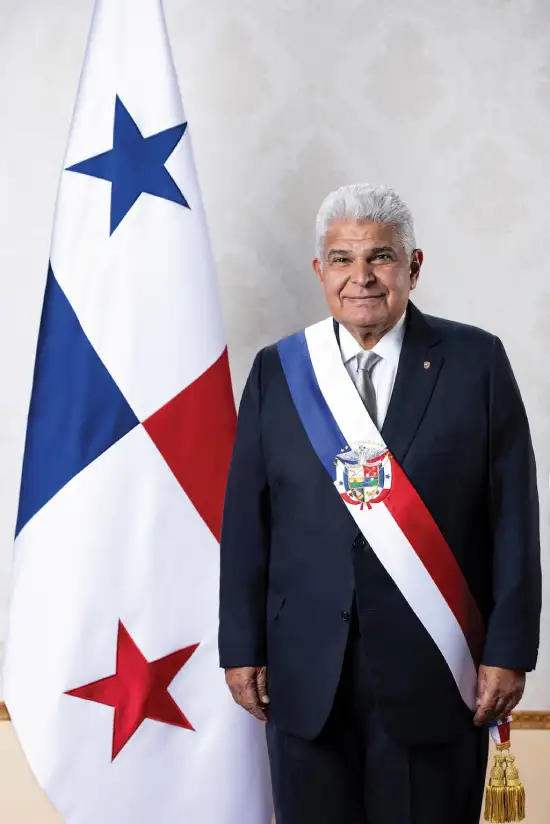
José Raúl Mulino
President of the Republic of Panama
José Raúl Mulino, born on June 13, 1959, in David, Chiriquí, Republic of Panama, was elected president in the general elections of May 5, 2024. A lawyer by profession, Mulino has extensive experience in the legal, governmental, and political spheres.
Educated at Colegio San Vicente de Paul in David, Chiriquí (now known as Colegio San Agustín), Mulino continued his higher education at Santa Maria La Antigua University (USMA) in Panama, where he earned a Bachelor of Laws and Political Science degree in 1982. He subsequently obtained a Master of Laws in Maritime Law from Tulane University in New Orleans in 1983. Professionally, Mulino began his career as a lawyer in 1983 and distinguished himself as a founding partner of the law firm Fábrega, Molino y Mulino in 1988, where he remained until 2015. Since then, he has served as counsel at the law firm Mulino & Mulino. His experience extends to the international maritime sector, where he has represented shipping companies, shipowners, and banks in Europe and Asia since 1989.
Mulino's public career is equally remarkable. He began as Vice Minister of Foreign Affairs in 1990, and in 1993 he was appointed Minister of Foreign Affairs, a position he held until 1994. During his tenure, in April 1994, he was the first Panamanian Foreign Minister to visit Russia after 90 years of diplomatic relations. He also served as an alternate magistrate on the Civil Chamber of the Supreme Court of Justice between 1994 and 1996. In the Ricardo Martinelli administration, he was appointed Minister of Government and Justice in 2009 and then Minister of Public Security in 2010, a position he held until 2014. In the political arena, Mulino has led several parties, including serving as president of the Solidarity Party (2005-2008) and the Patriotic Union Party (2008-2011). In 2018, he was a presidential pre-candidate for the Democratic Change Party. Finally, on March 5, 2024, he became the presidential candidate for the Realizando Metas (RM) party and won the general elections in May of that same year.
Mulino is also known for his participation in the National Civic Crusade, where he played a key role in the opposition to the regime of Manuel Antonio Noriega, contributing to its fall in 1989. He has also held positions in the business sector, serving as president of APEDE and vice president of CONEP between 1989 and 1990.
José Raúl Mulino has been married to Maricel Cohen since 1985 and is the father of four children: José Raúl Jr., Monique Alexandra, Alexandra Victoria, and Verónica Isabel Mulino Cohen. He is also the grandfather of four grandchildren: Sofía Victoria, Samuel Ignacio, Isabella Mía, and Camila Mar.
Mulino has received numerous decorations in recognition of his service, including the Grand Cross of the Republic of Panama, Colombia, Argentina, the Governor of Antioquia, and the Peruvian Naval Merit Cross, among others.
On July 1, 2024, Mulino assumed the presidency, becoming Panama's seventh elected president in the democratic era, marking a new chapter in the country's political history.
Zoom on
The Palace of Herons
The residence of the President of the Republic of Panama is called Herons' Palace because of the two herons donated by the poet Ricardo Miró to President Belisario Porras in 1922. Since then, these birds have become honorable inhabitants of the Palace. This building in the past housed a national bank, then customs offices, until it was used as a warehouse.
Inside, you can find different murals and sculptures alluding to the values and history of Panama.
The Palace of Herons or Presidential Palace is a symbol of Panamanian national identity and tells a story dating back more than 300 years when local authorities left the ancient city of Panama, destroyed by the troops of pirate Henry Morgan, at the search for a site that would allow them to be protected against future attacks.
After having established a temporary site in San Juan Bautista, Penonomé, the authorities, led by Governor Fernandez de Cordoba and Mendoza, decided to settle in the site called Ancon (now Casco Viejo) to protect themselves against future attacks.
Before the death of Governor Fernandez de Cordoba and Mendoza on April 8, 1673, Bishop Antonio De León and the Royal Magistrate Luis Lozada de Quiñones took office and continued the project of building the wall.
Avant la mort du gouverneur Fernandez de Cordoba et Mendoza, le 8 avril 1673, l’évêque Antonio De León et le magistrat royal Luis Lozada de Quiñones ont pris leurs fonctions et ont poursuivi le projet de construction du mur.
Working on this long wall, Lozada built his ostentatious home in 1673. He was dismissed after being accused by members of the community of misusing the building materials for the wall.
This manor became known as Palace of Herons. Although the building has been remodeled several times, it has always retained this colonial design that makes it imposing as it brings an elegant and sophisticated side.
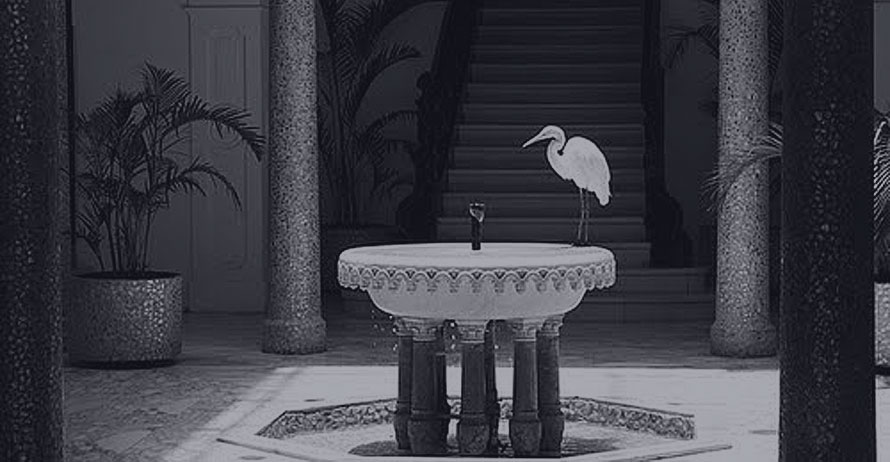
At the beginning, around 1740, the Palace of Herons served as the customs office. However, 16 years later, in 1756, the building was the target of a fire that destroyed a significant portion of its infrastructure.
After having been restored, the Palace of Herons was used as a depot in 1821 then it also housed the Normal School for Boys in 1872, head office of the government, headquarters of the National Bank, until becoming the presidential palace in 1875. At that time, the Panamanian state was part of Colombia.
In 1880, the palace is more resplendent than ever, because starting from this date, the electric light is installed in the building.
Like all infrastructures, the Palace of Herons over the years has deteriorated. In this year 1922, President Porras decided to make a new restoration, but this time incorporating the second and third floors and remodeled the presidential dining room, the yellow room and the central patio.
The works left the footsteps of one of the most renowned architects of the time, Leonardo Villanueva-Meyer, who worked hard to leave a perfect infrastructure without harming its appeal.
A remodeling was carried out on August 3, 1923. The building was then not only occupied by the Presidency of the Republic but also by the National Bank which could not be moved before 1938.
The same year, the painter Roberto Lewis accepted the request of President Juan Demóstenes Arosemena to decorate the presidential dining room with oil-painted murals representative of Panama's history and culture. The building hosted the different Presidents of the Republic with the exception of Presidents Ernesto Perez Balladares, Mireya Moscoso, Martin Torrijos, Ricardo Martinelli and Juan Carlos Varela.
Nowadays, the “Palacio de las Garzas” continues to tell stories in the old district of Panama City, and from there, with a privileged position and view, it is visited by hundreds of tourists every year.
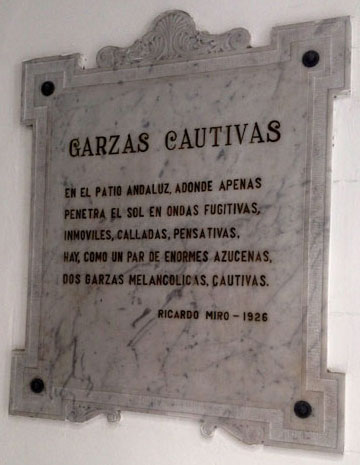
Ironically, the country's greatest poet, Ricardo Miro, who gave the 2 herons to President Belisario Porras wrote a poem to protest and demand his release. Today, the first verse of this poem can be read on a plaque in a corridor on the ground floor of the Presidency in tribute to his pen and his spirit admired by all who visit. That's it, this complete poem.
Garzas Cautivas, por Ricardo Miró
A doña Oderay de Lefévre
En el patio andaluz, adonde apenas
penetra el sol en ondas fugitivas,
inmóviles, calladas, pensativas,
hay, como un par de enormes azucenas,
dos garzas melancólicas, cautivas.
¡Quién sabe si una noche, al escondido
juncal, cerca a la orilla melodiosa,
una mano llegó, vio al par dormido,
lejos la madre tierna y afanosa,
y arrebató los pájaros del nido!
al vez fue en el corral que en la ribera
levanta frente al mar su empalizada
donde un día, al nacer la primavera,
en la sorda explosión de una alborada,
vieron la luz del sol por vez primera.
¡Y ellas no saben del azul...! Sus huellas
no serán polvo de oro tras su vuelo
a la indecisa luz de las estrellas;
y con sus ojos tristes ven el cielo
y no saben que el cielo es para ellas.
Acaso si una mano, de repente,
las echara a volar, tras un momento
de supremo estupor, abriendo al viento
sus vírgenes plumajes, blandamente
se irían a embriagar de firmamento.
Pero no volarán, ni bajo el rico
oro del sol se encenderán sus galas,
ni ensartarán estrellas en el pico,
ni abrirán a la luna el abanico
blanco y maravilloso de sus alas.
¡Melancólicas garzas...! Y en el frío
patio sin luz ni sol, sobre las zancas,
simbolizan la imagen del hastío;
y ni siquiera saben que son blancas
porque nunca se vieron sobre un río.
Y allí, bajo las penas de sus galas
inútiles -libélulas de hielo-,
dormitan sin un ansia ni un anhelo,
y no saben aún que tienen alas
y que las alas son para ir al cielo.
Melancólicas garzas que en el frío
patio sin sol ni luz, sobre las zancas,
simbolizan la imagen del hastío,
y que nunca supisteis que erais blancas
porque nunca os mirasteis sobre un río.
Hay almas cual vosotras que ni huellas
dejarán ni sabrán nunca del vuelo
que nos lleva a vivir con las estrellas,
almas que ven atónitas el cielo
y no saben que el cielo es para ellas...
Para ellas el oscuro, el escondido
patio andaluz en donde el sol no alumbra;
y van, cobardemente, sin ruido
y a través de una gélida penumbra,
en viaje al mar sin playas del olvido.